Sample Bag Selection: Heavy Duty, Ziplock, Geotech, Plain
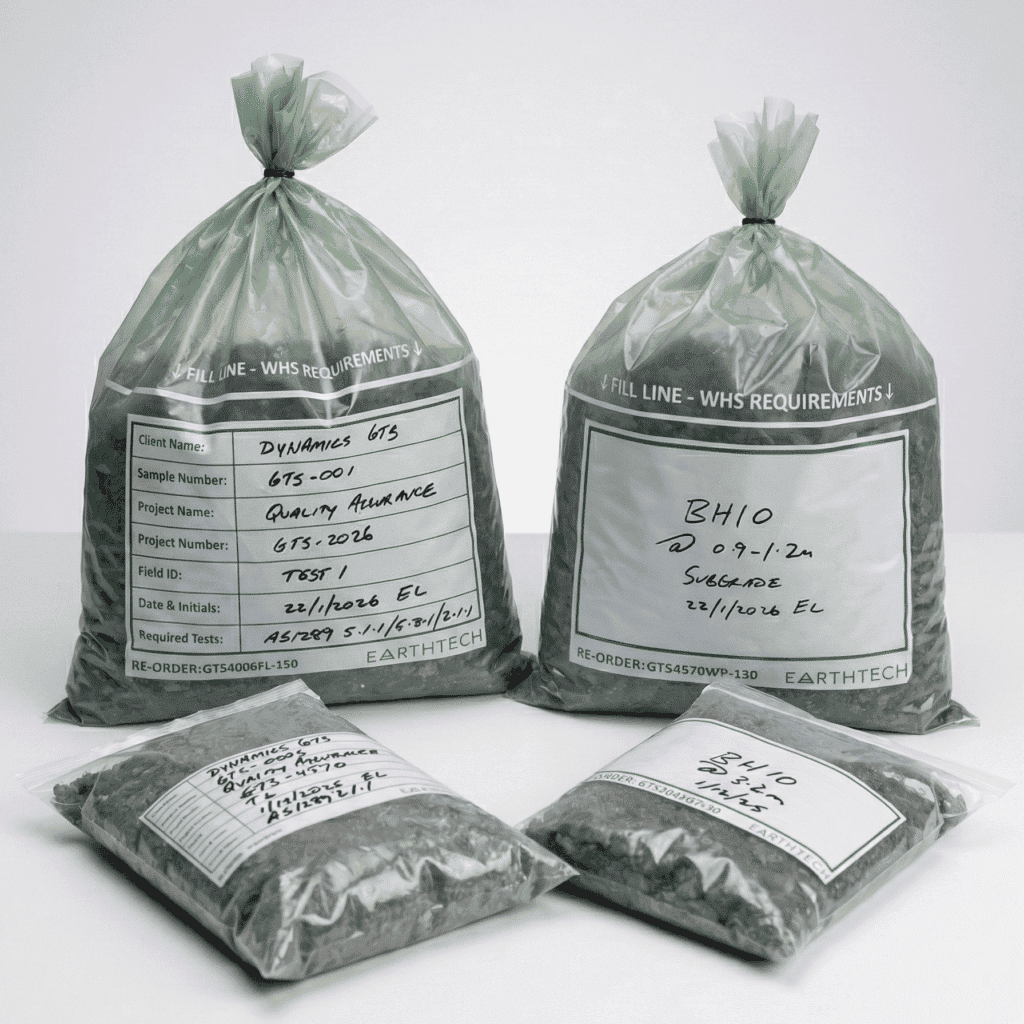
A drill program needs bags. The catalogue shows four geotechnical sample bag variants. The driller wants what they used last time. The lab wants something with a tabulated chain-of-custody panel. Procurement wants the cheapest option. Three different correct answers depending on what’s about to happen to the sample.
For operations where bags are the right call – and our previous piece on reusable sample containers vs disposable bags covers when they aren’t – choosing between variants comes down to three practical questions: what’s going in the bag, how the sample needs to be documented, and how far it has to travel.
Heavy Duty vs Ziplock
The first decision is closure type, and it’s driven by sample volume.
Heavy Duty Bags (125–150µm) are sized for bulk soil and aggregate sampling. Tied or sealed at the neck, with a reinforced double base seal and walls built to handle wet clays, abrasive gravels, and full-bag transport. Sizes run from 200×300mm up to 600×900mm. These are the standard choices from drill rigs, test pits, and bulk excavation.
Ziplock bags (90µm) are sized for laboratory subsamples and smaller field samples. The reusable press-seal preserves natural moisture content – critical for AS 1289.2.1.1 moisture content testing – and the high-clarity material lets the lab inspect contents without breaking the seal. Sizes run from 75×125mm up to 250×375mm.
Most geotechnical programs use both. Heavy Duty for primary samples, ziplock for moisture tins, geochem subsamples, and environmental fines. Ordering both formats from the same supplier means consistent material spec and the same SKU prefix system across the fleet.
Geotech vs Plain
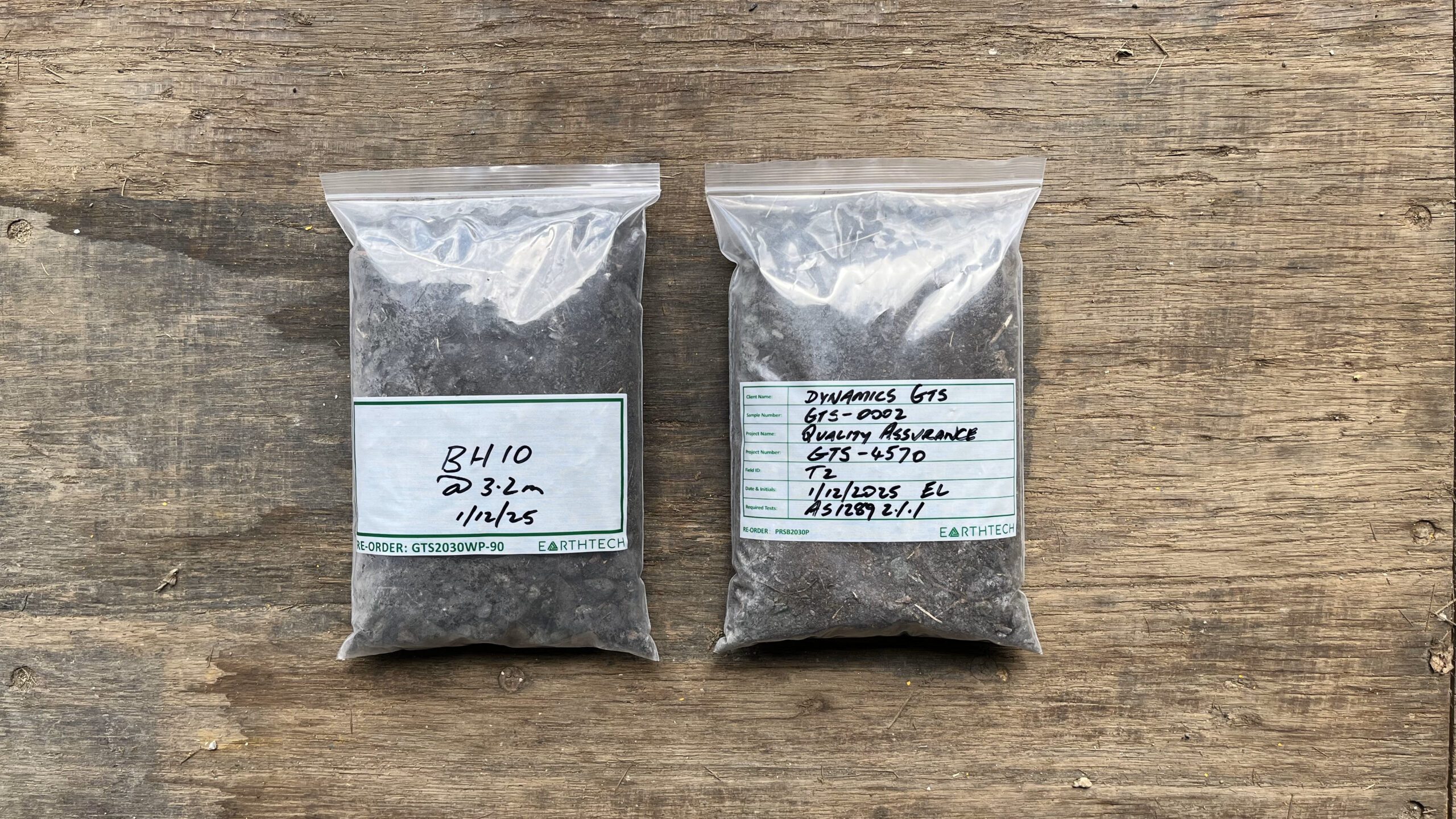
Both heavy duty and ziplock variants come with two panel styles, and the choice depends on whether the field documentation is standardised.
Geotech (tabulated) panel. A pre-printed grid with dedicated fields for Client/Project Name, Borehole or Sample ID, Date, Technician Initials, Sample Type, and Required Testing.
Designed for systematic sampling programs where consistent field documentation drives chain-of-custody and reporting accuracy. The standard choice for civil contractors and consultancies running multi-site investigations, and effectively the default for any program where the lab is going to receive samples from multiple field crews.
Plain (write-on) panel. A blank high-contrast white panel. Used where the project requires non-standard identifiers, where a single crew is documenting fewer samples, or where the bag is repurposed beyond strict geotechnical workflow – CMT, materials testing, environmental sampling, or general industrial use. If your organisation has a standardised log format that doesn’t match the Geotech grid layout, the Plain variant is the correct choice – stamp or print your own tabulation rather than fighting a pre-printed one.
Most operations end up specifying tabulated panels for primary geotechnical sampling and plain panels for everything else.
Microns: When and How to Specify
Wall thickness determines durability under load, and the right specification depends on what’s in the bag and how far it’s travelling.
90µm is the standard for ziplock bags. That’s roughly 80% thicker than commodity ziplock bags from a hardware supplier, which is what makes the seal hold under the weight of a wet soil sample rather than splitting at the press-line.
125µm is the standard for heavy-duty bags. It handles wet soils, soft clays, and routine site transport. For most geotechnical investigations under 100 samples, this is the right specification.
150µm is extra heavy-duty. The marginal cost over 125µm is small. Still, the case for upgrading is specific: abrasive gravels with sharp fragments, long-distance freight, extended outdoor storage before laboratory submission, or any program where a bag failure means re-sampling rather than re-bagging at the lab. For programs running 200+ samples through difficult ground, consolidating to 150µm reduces wastage rates and protects the chain of custody.
The polymer is the same across all heavy-duty variants: 100% recycled, UV-stabilised polypropylene, manufactured in Australia. UV stabilisation matters when bags sit on a bench under shade cloth between sampling and lab pickup. Non-stabilised polypropylene degrades visibly within weeks of exposure to Australian summer conditions. The EarthTech® range is stabilised against this as standard.
Practical Specification for an Australian Investigation
For a typical geotechnical investigation:
| Situation | Recommended Specification |
|---|---|
| Test pits and bulk soil sampling | Heavy Duty Sample Bags (Geotech) 400×600mm (GTS4060-150) for general fill, 600×900mm (GTS6090-150) for larger volumes. |
| Borehole drilling, primary samples | Heavy Duty Geotech 300×460mm (GTS3046-150), sized to fit standard core handling. |
| Moisture content tins / AS 1289.2.1.1 | Ziplock Sample Bags (Geotech) 75×125mm (GTS75125-90) or 125×180mm (GTS12518-90), maintaining seal until lab dispatch. |
| CMT subsampling | Ziplock Sample Bags (Plain) 200×300mm (GTS2030WP-90) for project-specific labelling. |
| Environmental fines, contaminant samples. | Ziplock Geotech 200×300mm (GTS2030-90) for documented chain of custody. |
| Custom labelling on heavy-duty bags. | Heavy Duty Sample Bags (Plain) for bulk samples requiring stamped or printed organisation-specific identifiers. |
Quantities are normally specified by box, not by individual bag. Box quantities range from 100 (largest sizes) to 1,000 (smallest ziplock sizes). For a 500-sample investigation, that’s typically two boxes of Heavy Duty Geotech and one box of small ziplock in a single order rather than a procurement cycle.
WHS Fill Line at 25kg: Why it’s printed on the bag

Heavy-duty bags carry a printed WHS fill line – a horizontal indicator showing the maximum fill volume for a 25kg manual handling weight.
The 25kg threshold comes from Safe Work Australia’s guidance on manual handling. It’s the load above which mechanical assistance, two-person lifting, or task redesign should be considered. Without a fill line, bags get filled to whatever the driller can carry – sometimes heavier than they should be, because a half-empty bag is awkward and feels wasteful. Musculoskeletal disorders account for around a third of serious workplace injuries in Australia, and over-exertion during lifting drives most of them.
The fill line lets field staff load bags within compliant weights without weighing each one. For programs working under tight WHS scrutiny – government tenders, large contractor sites, or any operation reporting against safety KPIs – having the limit printed on the consumable rather than relying on operator judgement reduces the exposure significantly.
Learn more about the Dynamics GTS EarthTech® sample bag range.
Ordering details: EarthTech® sample bags are available in Geotech (tabulated) and Plain (write-on) panel variants, in Heavy Duty (125–150µm) and Ziplock (90µm) formats. All variants are manufactured in Australia from 100% recycled UV-stabilised polypropylene. Custom branding and project-specific tabulation available on request.
Request Quote → or call 1800 518 051.